
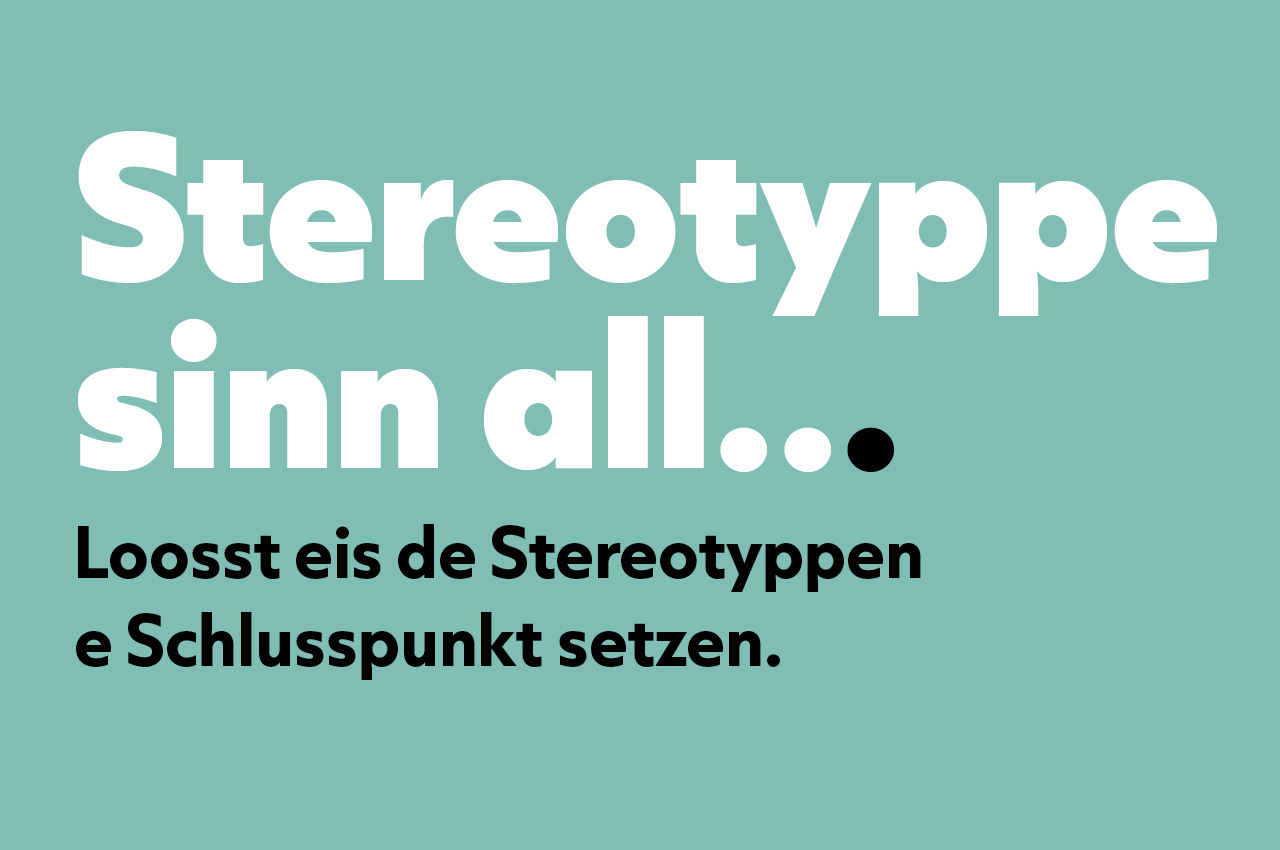
Stereotypes Campaign
What are stereotypes?
A stereotype is a simplified idea we have about a thing or a person. Other similar terms include “prejudice” or “putting people into boxes.”
Stereotypes help us understand everyday things quickly and easily and give us clues about how we should interact with or use them.
The stereotype of a chair, for example, would be something with four legs that you can sit on.
When we see something that roughly fits this description, we know: I can sit on this, it’s a chair.
However, we are all aware that a chair is not just four legs and a seat, and that each chair is slightly different. We also know that some chairs don’t have four legs, and that not everything with four legs that you can sit on is a chair. A bench or a table are good examples.
So stereotypes can be useful, but they are often incomplete, not entirely accurate, and sometimes entirely wrong.
Stereotypes and discrimination
Stereotypes often lead to prejudices. We form an opinion about something or someone without really having engaged with it. We lump everything together, and statements like “They’re all like that…” appear.
When, based on these prejudices, people are treated differently because “they’re all like that” and “the others are different,” this is what we call discrimination.
People in a similar situation are treated differently because an opinion has been formed about them that does not necessarily reflect reality. This can have serious consequences for these individuals.
The campaign
To raise awareness about the dangers of stereotypes, the CET decided to address this topic in a campaign. It was important to us not to reinforce common stereotypes but to put an end to them.
Whenever stereotypes are addressed, there is always a risk of hurting people. We are aware of this and have tried to design a campaign that includes as many people as possible. However, decisions always have to be made, and it is not possible to create unlimited versions.
If you nevertheless feel excluded by the wording, or if the campaign makes you feel uncomfortable or hurt, please let us know. You can contact us at: info@cet.lu.
Of course, you are also welcome to send us positive feedback.